
Mobile NDIS assessments for NDIS participants across Melbourne
NDIS assessments in Melbourne give the NDIA, your support team and you clear, professional evidence about what a person can do, what is hard and which supports would help. Voyager Allied Health offers mobile assessments for NDIS participants and applicants across Greater Melbourne.
✓ Assessments at home, school or in the community
✓ Plain-language written reports
✓ Plan-managed, self-managed and NDIA-managed
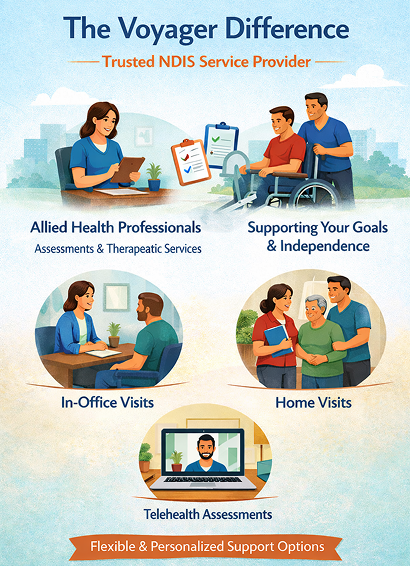
This page explains the main assessment types, when evidence is needed, who completes it, how funding may work, and what happens on the day. It also looks at Melbourne-specific factors such as housing stock, trams and trains, weather and distance, and answers common questions about reports and plan reviews.
What you get
A structured assessment and a written report that describes needs, strengths and recommended supports in plain language.
Common types
Functional capacity, home and environment, equipment and assistive technology, therapy progress, communication, mealtime and mobility assessments.
Where
At home, school, work, day programs or in the community across Greater Melbourne. Locations are confirmed at intake.
Funding
Often Capacity Building supports such as Improved Daily Living, depending on your plan. Check with your coordinator or the NDIA.
What are NDIS assessments in Melbourne used for?
An NDIS assessment collects information about how a person’s disability affects daily life and which supports might help, then turns that information into a written report. Reports are used to apply for access, to prepare for a plan review, to justify equipment or home changes, or to track progress against goals.
Assessments are not tests you can pass or fail. A good one is a conversation, some observation and, where relevant, standardised tools. It should describe strengths as clearly as difficulties, because the NDIS looks at what supports are reasonable and necessary for the person. A report cannot guarantee a funding decision, but a clear one makes your situation easier to understand.
Assessment, diagnosis and evidence: three different things
A diagnosis comes from a medical or psychological professional and names a condition. An assessment, such as a functional capacity assessment, describes how that condition affects everyday activities like self-care, communication, learning, mobility and managing money. Evidence is the combined set of reports and letters you give the NDIA. You usually need both a diagnosis and functional information, and different professionals provide each.
Who completes NDIS assessments
Assessments are completed by qualified health professionals within their scope: occupational therapists, physiotherapists, speech pathologists, dietitians, psychologists and others. Which professional you need depends on the question. For equipment or home access, an occupational therapist is common. For swallowing, a speech pathologist. For mobility, a physiotherapist. Ask any provider about their qualifications and experience with your type of assessment.
What the NDIA looks for
The NDIA wants to see that a support is related to disability, helps the participant pursue goals, represents value for money and is likely to be effective. Reports that connect observations to specific supports and give clear reasons tend to be the most useful. Rules change, so check ndis.gov.au for current requirements.
How are NDIS assessments funded in Victoria?
NDIS assessments are commonly funded from Capacity Building supports, often Improved Daily Living, but it depends on your plan. Some participants have no funds set aside, in which case a coordinator can discuss options with the NDIA. Applicants who are not yet participants may need to cover early evidence themselves, so ask about costs in advance.
Assessments before access and during a plan
Reasonable and necessary, in practice
Plan-managed, self-managed and NDIA-managed
Assessments before access and during a plan
If you are applying to the NDIS, the NDIA asks for evidence of disability and its impact. Your GP, specialist or treating therapists may already hold reports. If you are already a participant, assessments commonly support a plan review, a change of circumstances or an equipment request. Funding rules for each situation differ, so confirm with your plan manager or the NDIA first.
Reasonable and necessary, in practice
The NDIS funds supports that are reasonable and necessary. In practice that means a report should link the support to a goal, explain why alternatives are insufficient and make sense in your overall plan. Quotes for equipment or modifications are often needed in addition to assessments. A therapist can advise but cannot decide funding.
Plan-managed, self-managed and NDIA-managed
Plan managers pay invoices from the budget. Self-managed participants pay and claim. NDIA-managed participants usually need registered providers. We explain the paperwork before work starts and set out costs, report writing and travel in a written service agreement.
Questions about your plan or funding? Talk to us before you book. There is no pressure.
What happens during an assessment with Voyager?
Most assessments follow a predictable pattern: gather background, meet the person, observe real activity, analyse the findings and write a report. How long each step takes depends on complexity. Simple reviews may be shorter, while multi-domain assessments need more time and sometimes more than one visit.
1
Referral and scoping
We confirm the purpose of the assessment, who it is for, the deadline and which professional is best placed to complete it.
2
Background review
We review your plan, diagnoses, previous reports and goals so you are not asked the same questions twice.
3
Meeting and observation
The assessor talks with the participant and supporters, then observes daily activities in the real environment.
4
Analysis and recommendations
Findings are compared with the participant’s goals, and recommendations are linked to evidence and specific supports.
5
Report and feedback
You receive a written report and an opportunity to ask questions or request corrections to factual errors.
Before the visit
Gather any plan documents, medical letters, previous therapy reports, school documents and a short list of questions. Think about the day-to-day tasks that are hardest and which are going well. Photos or short notes about a typical day help, especially if the participant will find it tiring to explain.
After the visit
You should receive a report in plain language that covers background, methods, findings, recommendations and next steps. If anything is wrong, ask for it to be corrected. If you disagree with a recommendation, talk to the assessor. A good report reflects the person’s voice as well as the professional’s view.
Ready to begin? Send a referral or call, and we will confirm your next step.
Types of NDIS assessments available in Melbourne
Different questions need different assessments. Below are the types participants and coordinators most often ask about. Voyager can discuss which suits your situation and whether more than one is needed.
Functional capacity assessments
A functional capacity assessment, often called an FCA, looks at how disability affects everyday activities across areas such as self-care, domestic tasks, communication, social interaction, learning, mobility, planning and managing money. It typically involves an interview, observation, standardised tools and review of records. It describes impact on function and is not a diagnostic test. Occupational therapists commonly complete these.
Home and environment assessments
A home assessment looks at whether a dwelling is safe and accessible for a person’s needs: entries, bathrooms, kitchens, bedrooms, lighting and circulation space. It can recommend simple changes such as rails or ramps, or larger modifications that need quotes and approvals. Melbourne has many older houses with steps, narrow doorways and small bathrooms, as well as newer estates with open plans, so local housing stock shapes recommendations.
Equipment and assistive technology assessments
Assessors trial and recommend items such as wheelchairs, shower chairs, beds, communication devices or smart home tools. They consider fit, safety, cost, training and maintenance. Complex items need specialist input and quotes. Avoid buying equipment before an assessment, because the wrong item can be unsafe or not funded.
Therapy progress and outcome reports
Therapy progress reports summarise what has been done, what changed and what is recommended next. They are useful before plan reviews and when deciding whether to continue a service. Outcome measures, goal attainment scales and brief summaries help show change over time.
Communication, mealtime and mobility assessments
A speech pathology assessment explores speech, language, communication aids and swallowing. An NDIS dietitian assessment reviews growth, nutrition and mealtime support. A physiotherapy assessment looks at strength, balance, mobility and falls risk. These can be combined into a team report.
NDIS assessments for children, young people and school
Children and young people are assessed in their family, kinder and school contexts, and reports must be understandable to non-clinical readers. The aim is to capture how a child functions across settings and which supports would help them learn, play and participate.
Early years and developmental concerns
For young children, assessment may explore play, communication, motor skills, sensory responses, behaviour and daily routines. Findings guide early childhood supports and support access requests. See early childhood intervention in Melbourne for how assessment links with therapy planning. Government supports for young children are also changing, so check ndis.gov.au for current details.
School-age assessments
For school-aged children, assessments can focus on handwriting, attention, sensory needs, social participation, communication or mealtime access at school. With consent, assessors can speak with teachers and wellbeing staff in Victorian schools, and recommendations may support adjustments or funding applications made through the school as well as the NDIS.
Transition to adulthood
Teenagers and young adults often need assessments around leaving school, starting TAFE or university, working, travel training or moving towards independent living. These assessments help identify skills to build and supports to request. A rehabilitation counsellor can add goal planning, and an occupational therapist can assess practical skills.
NDIS assessments for adults and older participants
Adults often seek assessments at key points: applying for the NDIS, preparing for a plan review, changing housing, returning to work or when health changes. Evidence should reflect the current situation, so older reports can lose value as circumstances shift.
Supported accommodation and housing
Participants considering shared living, supported independent living or specialist disability accommodation may need assessments describing their support needs, safety requirements and environmental features. These are specialised, with specific evidence requirements, and some are completed by clinicians with additional training. Voyager will tell you if a particular assessment is outside our scope and help you find the right professional.
Changes in health or function
After a fall, stroke, surgery or deterioration of a condition, a reassessment can capture what has changed. This helps your team adjust therapy, equipment and support hours, and gives the NDIA evidence if a change of circumstances request is needed.
Capacity for daily tasks and risk
Some assessments focus on safety, such as showering, cooking, medication management, mobility in the home or community access. Findings are used to plan supports that protect safety while respecting dignity and choice.
NDIS planning, new framework planning and what it means for evidence
The way the NDIS plans is evolving. The NDIA has described new framework planning, which includes a guided conversation with a trained NDIS assessor, with a staged rollout starting from mid-2026 with a small group of participants and expanding gradually. According to the NDIA, children under 18 are excluded from the initial changes and current plans remain in place until a participant transitions.
Will therapist reports still matter?
Therapist reports are expected to remain valuable because they describe daily life in detail and show what has helped. Even when a conversation with an NDIS assessor is part of planning, clinicians’ reports add context from long-term observation. Do not stop collecting evidence because planning is changing.
What to do now
Keep reports organised by date and topic, ask therapists to write in plain language, and note what is working and what is not. Check ndis.gov.au for updates, since timing and details can change. If you are unsure whether the new process applies to you, ask your planner, local area coordinator or support coordinator.
Reviews and appeals
If you disagree with an NDIA decision, you can ask for an internal review and, if needed, apply to the Administrative Review Tribunal. Assessments and reports often form part of this evidence. Legal and advocacy services in Victoria can help with the process, and we can provide reports but not legal advice.
Who does what: assessments, therapy and other services
An assessment answers a question. Therapy then works on it. Because Voyager provides several allied health services, assessments can lead directly to therapy planning when that is what you want, or you can take the report to another provider.
| Service | Typical assessment question | Related page |
|---|---|---|
| Occupational therapy | How do daily tasks, sensory needs and home setup affect participation? | Occupational therapy in Melbourne |
| Physiotherapy | What movement, balance or strength issues limit mobility? | NDIS physiotherapy in Melbourne |
| Speech pathology | How do communication or swallowing needs affect safety and participation? | Speech pathology in Melbourne |
| Dietetics | Is nutrition adequate, and how can mealtimes be made safe? | NDIS dietitian in Melbourne |
| Rehabilitation counselling | What goals, barriers and supports matter for work, study or adjustment? | NDIS rehabilitation counselling in Melbourne |
For wider context, see NDIS allied health therapies in Melbourne and the national NDIS assessments overview.
How Melbourne shapes assessments, and where we work
Greater Melbourne’s size, housing, transport and climate affect what an assessor sees and recommends. Mobile assessments bring clinicians to the environment that matters, so recommendations fit real life. Service areas and travel arrangements are confirmed at intake.
Melbourne CBD · Carlton · Fitzroy · Richmond · South Yarra · Footscray · Collingwood · Southbank
Brunswick · Coburg · Preston · Reservoir · Craigieburn · Broadmeadows · Essendon · Epping
Werribee · Point Cook · Sunshine · Tarneit · Melton · Williamstown · Hoppers Crossing
Dandenong · Cranbourne · Clyde North · Narre Warren · Berwick · Pakenham · Springvale
Box Hill · Doncaster · Ringwood · Glen Waverley · Knox · Lilydale · Mitcham
St Kilda · Brighton · Moorabbin · Frankston · Mentone · Mornington Peninsula
These are places where people commonly ask about support, not a guarantee of coverage.
Inner suburbs have terraces, units and apartments with stairs, lifts and narrow entries. Middle and outer suburbs include brick veneer houses, townhouse developments and new estates where blocks are small and houses are large. Assessors look at stairs, thresholds, bathrooms, laundry, driveways, letterboxes and access from car to door because those details decide daily independence.
Melbourne has trams, trains, buses and the myki system. Tram accessibility varies by route and stop, and some stations have steps or gaps. A community-based assessment can test a real journey, noting platform access, timetable use, crowding and fatigue. Travel training recommendations often start from that kind of observation.
Melbourne weather can change fast and summer heat can affect fatigue, temperature regulation and equipment use. Long distances between outer suburbs and services can make clinic visits hard. Mobile assessments may reduce travel burden, and telehealth may suit some follow-ups such as reviewing a draft report.
Want to check we can visit your suburb? Get in touch and we will confirm.
Working with your coordinator, plan manager and health team
An assessment is more useful when everyone understands it. With consent, Voyager shares relevant findings with support coordinators, plan managers, GPs, specialists and educators, and we can explain results in a meeting if that helps.
Briefing your support coordinator
Support coordinators often submit evidence or prepare plan review documents. Tell them why you are having the assessment and ask what they need in the report. We aim to write reports that answer the question asked, without padding.
Keeping the participant at the centre
Assessments can feel intrusive. We explain what will happen, ask what the participant is comfortable with and take breaks. The participant’s voice appears in the report, including preferences about privacy, routines and cultural needs.
Accuracy, consent and privacy
Reports are factual and based on what was observed and reported. You can ask to review a draft for errors. Information is shared with your consent and in line with privacy obligations, so you decide who receives a report.
Why choose Voyager Allied Health for NDIS assessments in Melbourne?
You want an assessment that is thorough, understandable and useful. Voyager is a mobile allied health provider that works with plan-managed, self-managed and NDIA-managed participants, explains costs in writing, and coordinates across several therapies.
More detail
- Real-environment focus. We see the home, school or community where the challenges happen.
- Plain-language reports. Short sentences, clear headings and practical recommendations.
- Cross-service thinking. Assessments across occupational therapy, physiotherapy, speech pathology and dietetics can be coordinated.
- Consent-led. You control who receives your information.
- Honest scope. If an assessment needs a different specialist, we will say so.
Read about our approach on the team page or browse inspiring stories.
Comparing providers? Ask us anything before you decide.
How to choose an NDIS assessment provider in Melbourne
Because assessments can influence major decisions, it pays to check how a provider works before you book. These questions work for any provider.
Questions to ask any NDIS assessment provider
- Which professional will complete the assessment, and what are their qualifications?
- What is the purpose and scope, and what will the report include?
- How long will the visit take, and where will it happen?
- How will you involve the participant and their family?
- What is the turnaround for the report, and can I review a draft?
- What are the costs for assessment, travel and report writing?
Warning signs
Be wary of providers who promise a funding outcome, write reports without meeting the person, use identical wording for every client, pressure you to buy equipment from a particular supplier, or cannot explain how the assessment links to your goals. An honest provider explains limits and encourages questions.
Frequently asked questions about NDIS assessments in Melbourne
What is an NDIS functional capacity assessment in Melbourne?
It is an assessment, often by an occupational therapist, that describes how disability affects everyday activities such as self-care, communication, mobility and managing tasks. It combines interview, observation and tools, and results in a written report. Voyager can discuss whether a functional capacity assessment suits your NDIS situation in Melbourne.
Do I need an assessment to get on the NDIS?
Access requests need evidence of disability and its impact, which can include reports from doctors and therapists. A functional assessment is one useful form but not the only one. Check current requirements on ndis.gov.au or ask the NDIA, and bring any existing reports to your first conversation.
How long does an NDIS assessment take?
It depends on the type and complexity. Some are a single visit of an hour or two, while others need several visits and time to write the report. We explain expected timeframes at intake, because they depend on clinician availability and the detail required.
Who pays for NDIS assessments?
Participants often use Capacity Building funds such as Improved Daily Living, but it depends on the plan. Applicants who are not yet participants may need to pay for evidence themselves. Ask your coordinator or the NDIA before booking, and read the service agreement carefully.
Can assessments be done at home in Melbourne?
Yes. Voyager provides mobile assessments at home, school, work and community settings across Greater Melbourne. Seeing the real environment makes findings more accurate. Locations and travel arrangements are confirmed when you contact us on 0493 576 868.
Will an assessment guarantee funding?
No. The NDIA decides what is reasonable and necessary based on all the evidence. A clear assessment can help explain why a support matters, but it cannot guarantee a decision. If you disagree, you can ask for a review and seek advocacy support.
What happens with new framework planning?
The NDIA has announced new framework planning with a guided conversation with a trained assessor, rolling out in stages from mid-2026. Children under 18 are excluded from initial changes. Current plans continue until transition. Therapist reports are still expected to be useful. Check ndis.gov.au for updates.
Can one provider assess several areas at once?
Often yes, if the right professionals are involved. Voyager can coordinate occupational therapy, physiotherapy, speech pathology and dietetics so findings fit together. If an area falls outside our scope, we will tell you and suggest suitable specialists.
Can I see the report before it is finalised?
Many providers will let you review a draft for factual errors, and Voyager aims to do the same where timeframes allow. You can ask for corrections to facts. Professional opinions remain the assessor’s, but they should be explained clearly.
What should I do if I disagree with a report or decision?
Talk with the assessor first, since misunderstandings are common. If a decision from the NDIA concerns you, you can ask for an internal review and then apply to the Administrative Review Tribunal. Advocacy services can help. For general questions, see our FAQ page.
Book an NDIS assessment in Melbourne
A short call is all it takes to start. Tell us who the assessment is for, why it is needed and any deadlines. We will explain which assessor and type of report fit best, how costs work and when we can visit. You can get in touch or make a referral at any time.
Other supports across Melbourne
Many families combine assessments with early childhood intervention in Melbourne or ongoing therapy. If you are looking in another city, see Sydney or Brisbane.
Other NDIS services in Melbourne
NDIS Assessments in other cities
Get Clear Evidence in Melbourne
Talk with Voyager Allied Health about the assessment you need, your deadlines and your plan. We will explain every step in plain language.